CIGA design Hunter Tourbillon vs Hunter Titanium vs Hunter Vintage
Official differences among three Hunter models: $1,999 hand-wound CD-011 tourbillon, $899 automatic CD-07 titanium with 5 ATM, and $599 vintage automatic with 3 ATM and a 40-hour reserve.
Disclosure: This page may contain affiliate links. They do not influence our editorial conclusions. Read the disclosure.
Our pick
- See price at CIGA design
Top pick
CIGA design
CIGA design is a mechanical-watch brand that sells skeleton, tourbillon, and Earth-dial collections such as Hunter, Blue Planet, Edge, Everest, and Zodiac from...
CIGA design Hunter Tourbillon vs Hunter Titanium vs Hunter Vintage

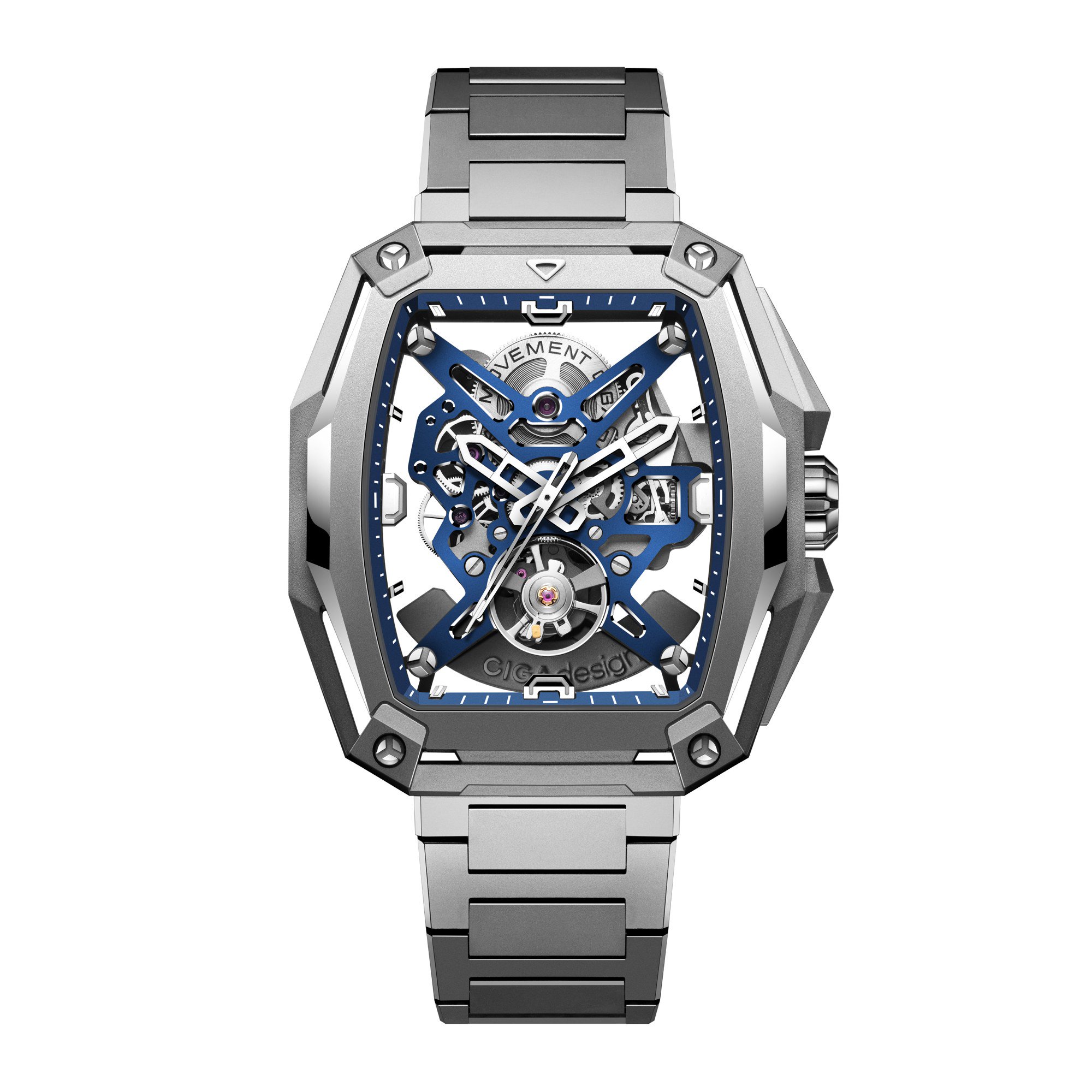
CIGA design’s Hunter line currently includes at least three skeleton watches with official product pages: the hand-wound Hunter Tourbillon, the automatic Hunter Titanium, and the automatic Hunter Vintage. This comparison uses those listings as they stood on November 18, 2026. It is not a wear test and does not rank “which watch feels better on the wrist.” It maps the facts the brand actually published—price, movement, reserve, materials, water-resistance figures where they exist, and box contents—and it flags the gaps.
A closer look at the $1,999 tourbillon is in the Hunter Tourbillon review. Shipping and returns are in the shopping guide. How the two-year warranty treats water use is in the warranty guide. Official add-on terms that currently name the Tourbillon and the Titanium, but not the Vintage, are in the 2026 Nico x Hunter news. The catalog also lists a Hunter Steel at $599, which is a fourth Hunter reference and is not one of the three pages compared in detail here.
Shop the official catalog through /go/ciga-design.
Price and style choices
The Tourbillon is $1,999 in Blue, Carbon, or Silver. The Titanium is $899 in the same three style names. The Vintage is $599 in Rose Gold, Sand Gold, or Brown Gold. Those figures are list prices from the official product records in USD. The Tourbillon therefore sits $1,100 above the Titanium and $1,400 above the Vintage on the pages reviewed.
The first two watches share a cold metal palette. The Vintage is the only one of the three whose official copy highlights “warm-toned colorways.” If your decision is mostly about finish, that is the documented split: Blue/Carbon/Silver on the two higher references, and three gold-toned options on the Vintage.
Movements, reserves, and what is left unsaid
The Tourbillon uses a self-developed CD-011 caliber, described as a hand-wound skeleton tourbillon with twin barrels and a 72-hour power reserve. It is the only one of the three that is not automatic and the only one whose official description names a tourbillon.
The Titanium uses a self-developed CD-07, described as a skeleton automatic with a 4 Hz frequency and 24 jewels, plus a “KE-Efficient Rotor” in a compact 120° system. The Vintage also uses a self-developed CD-07, “running at 4 Hz with a 40-hour power reserve, 24 jewels,” and the same 120° KE-Efficient Rotor, visible through the open caseback. The Vintage page is the one that states the 40-hour reserve in plain terms. The Titanium page does not print a power-reserve figure in the six-point description reviewed here. This comparison does not fill that blank with the Vintage’s 40 hours.
Because two models share a CD-07 name, it is tempting to treat them as the same movement in different cases. The official text does not say they are identical in every respect. The Titanium copy emphasizes a back-to-front skeleton, Grade 5 titanium, and a leaner octagonal tonneau. The Vintage copy emphasizes front-to-back openwork in an “iconic three-layered tonneau,” with micro-sandblasted surfaces and selectively polished chamfers. Shared caliber names and divergent case stories can both be true; the product pages simply do not publish a parts list that would settle the point.
The Tourbillon’s 72-hour reserve is the longest official reserve in this trio. That figure comes with a hand-wound architecture, so the longer interval is not free of winding. There is no official statement on this comparison about how many turns CD-011 requires, or about accuracy.

Cases, water-resistance figures, and packages
All three official descriptions place the watches in a Hunter tonneau. The Tourbillon and the Titanium both mention Grade 5 titanium. The Vintage description does not name the case metal in the six-point block reviewed here, so this article does not invent one.
Water resistance is published for two models and not for the third. The Titanium listing includes “Swiss Super-LumiNova® & 5ATM.” The Vintage listing includes “Swiss Super-LumiNova® & 3ATM.” The Tourbillon listing does not include an ATM figure or a Super-LumiNova line. A 5 ATM watch and a 3 ATM watch are not equivalent on paper, and a watch with no printed rating should not inherit either number. The warranty policy still says a watch is meant to be used in water if the screw-down crown is sealed, and that an open crown during water exposure can void the warranty after testing. That policy is brand-wide language; it is not a substitute for a missing Tourbillon rating.
Package contents also differ. The Tourbillon box is listed as the watch, a titanium bracelet, a fluororubber strap, and a warranty card. The Titanium box is listed as the watch, a Grade 2 titanium bracelet with a 316L steel hidden clasp and push button, and a warranty card. The Vintage box is listed as the watch, a 316L steel hidden-clasp push-button bracelet, and a warranty card. Only the Tourbillon officially includes a fluororubber strap as standard. The Titanium is the one that specifies Grade 2 for its bracelet, which is a different grade from the Grade 5 case.
Which official page is for which job
If you want the documented tourbillon complication, the 72-hour reserve, a Grade 5 titanium case, and both a metal bracelet and a rubber strap in the box, the Tourbillon page is the one that states those facts, at $1,999. If you want an automatic CD-07, a Grade 5 titanium case, and a printed 5 ATM figure, at $899, the Titanium page is the match. If you want the lower $599 price, warm-toned styles, a printed 40-hour reserve, and a 3 ATM figure, the Vintage page is the match.
Two other official differences should not be ignored at checkout. First, the 2026 Nico page currently attaches complimentary-strap, extra-warranty, and watch-roll terms to the Tourbillon and the Titanium, not to the Vintage; read that page rather than assuming the Vintage is included. Second, all three product pages repeat the same short 15-day unused-return paragraph, with return freight on the customer when there is no quality issue, but the long return and refund policies still disagree on contacts and refund timing, as the shopping guide documents.
None of the three listings reviewed here publishes case diameter or weight. If those measurements decide the purchase, ask the company before you pay. Official pages remain the live source: the Tourbillon, Titanium, and Vintage listings, or /go/ciga-design.
Return costs can also change the real difference between a $599 watch and a $1,999 watch. On a no-quality-issue return, official pages place international freight and related charges on the customer, and the return policy says shipping paid on the outbound order is not refunded. A refused delivery can also lose the carrier’s refusal-return fee. Those terms apply to all three models in the short product-page return block. The dollar amount you might lose on a return is not published as a flat figure, because it depends on the destination and method, but it is not zero, and it is not smaller simply because the Vintage costs less. The shopping guide records the contact and timing disagreements in more detail.
Lume and finishing claims should stay attached to the page that makes them. Super-LumiNova is official language on the Titanium and Vintage listings only. The Vintage page also mentions layered finishing with micro-sandblasted surfaces and polished chamfers. The Titanium page mentions sharper chamfers and reduced mass on a leaner octagonal tonneau. The Tourbillon page talks about a refined front and an opened reverse, without a lume line. This comparison does not treat those finishing phrases as interchangeable, and it does not invent a lume specification for the Tourbillon.
If you are still choosing after reading the three official lists, write down the facts that are actually present: $1,999 hand-wound CD-011 with 72 hours and a two-strap kit; $899 automatic CD-07 in Grade 5 titanium with 5 ATM; $599 automatic CD-07 with a 40-hour reserve, 3 ATM, and warm-toned styles. Anything not on that list is a question for the company, not a number this article can supply.
References
Meet your guide
Lipeiguan
author
What to read next
 J.R. Dunn Shopping Guide: Official Authorized-Retailer Status, Appointments, and Variable Pricing Official J.R. Dunn pages present an authorized Rolex retailer in Lighthouse Point, official appointment and WhatsApp contacts, and official language that prices may vary. This shop...
 J.R. Dunn Anything Promise: Official One-Year Ring Protection and Its Limits Official J.R. Dunn Anything Promise copy includes one year of ring protection on qualifying purchases from $500 to $250,000, backed by Jewelers Mutual, with official exclusions. Th... J.R. Dunn Return Policy: Official 30-Day Jewelry, 10-Day Watch, and January 15 Holiday Windows Official J.R. Dunn refund-policy text gives jewelry 30 days from delivery, watches and loose diamonds 10 days on official online purchases, and an official January 15 extension for...