hygi.de Company Guide: Telgte Headquarters, Bunzl, and Official Figures That Do Not Match
Official hygi.de corporate pages place the 2004-founded shop in Telgte, inside Bunzl since 2023, and publish two different brand counts on the same about page. This guide records those official facts without merging them.
Disclosure: This page may contain affiliate links. They do not influence our editorial conclusions. Read the disclosure.
Our pick
- See price at hygi.de
Top pick
hygi.de
hygi.de is a German online shop for hygiene and cleaning supplies, occupational safety, HoReCa, and medical-device catalog goods, founded in 2004 and based in T...
hygi.de Company Guide: Telgte Headquarters, Bunzl, and Figures That Do Not Match

hygi.de is a German online shop for hygiene and cleaning supplies, occupational safety (Arbeitsschutz), hospitality and catering supplies (HoReCa), and medical-device catalog goods. Corporate pages live at www.hygi-unternehmen.de, and the shop itself is www.hygi.de. FAQ text names the merchant as hygi.de GmbH & Co. KG and calls it a pure online shop. This guide reads the corporate about page as of November 18, 2026. Figures on that same page do not all agree. Those disagreements are documented, not merged. This is not a warehouse tour, an ownership-diligence report, or a product test.
German and EU shipping rules are in the shipping guide. Invoice, SEPA, and minimum-order rules are in the payment guide. The own-brand paper line is in the Onobon review. How catalog and partner-shipping language should be read is in the catalog guide. The shop link is /go/hygi.
Founding, campus, and parent company
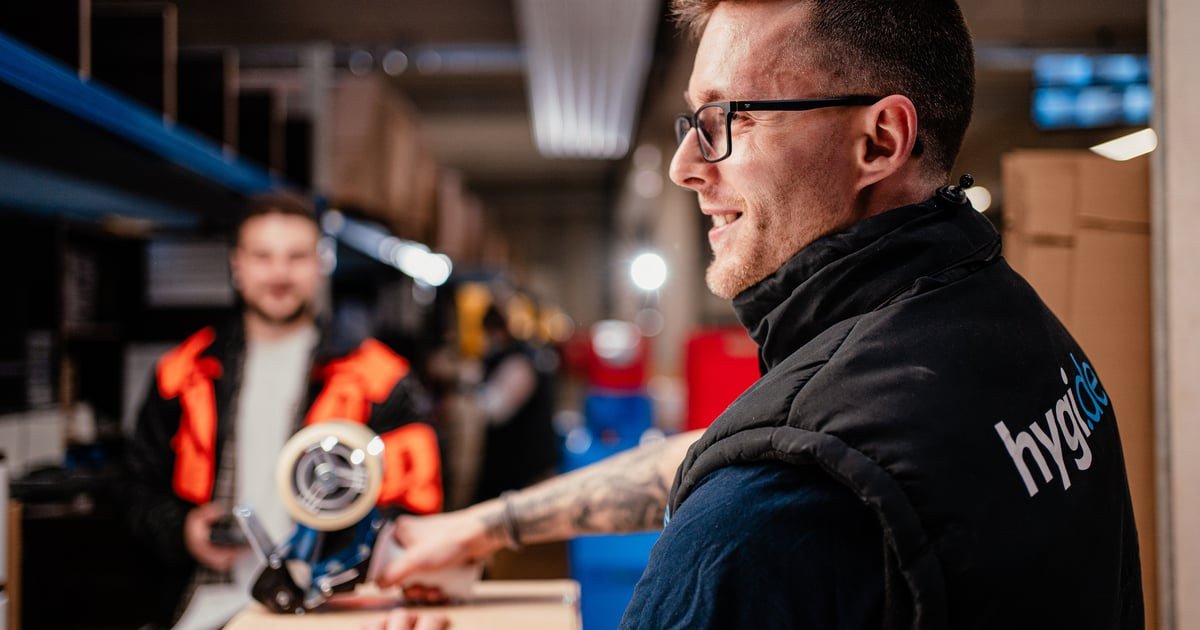
The “Zahlen, Daten, Fakten” block says the company was founded in 2004 by Christian Bleser, Daniel Bleser, and Ralf Penning. Since 2016 it has had a new headquarters for logistics and administration in the Telgter Kiebitzpohl, with more than 35,000 square meters of total area. A narrative block on the same about page calls the team “children of Münsterland” and describes a large logistics center in Telgte near Münster, with modern equipment, bright offices, a tournament-grade table-football table, and an artificial-turf roof terrace of more than 1,000 square meters with Wi-Fi. FAQ ordering text gives a concrete pickup address for the shipping center: Otto-Diehls-Str. 13-17, 48291 Telgte. Those place names all point to the same town; this guide will not invent a second campus.
The about page says that since 2023 the company has been part of “the Bunzl family.” A later block asks “Who is our principal shareholder Bunzl?” and answers that the parent is an international wholesale and distribution group headquartered in London. Bunzl supplies business customers worldwide, through subsidiaries, with packaging, hygiene articles, disposable products, and occupational-safety materials, and is active in more than 30 countries on both the manufacturing and trading sides. hygi.de presents that network as a way to strengthen its core competencies along the value chain. Those are corporate claims, not an independent valuation of the parent.
Ranking language in the facts block says the company is “Platz 101 der größten deutschen Onlineshops (EHI 2023).” Customer-facing copy also says the shop has been recognized as a “Top Shop” in its category for seven years running, and that it cannot know each of its “3 million” customers personally. Employee figures in the facts block are more than 300 staff, 41 nationalities, and an average age of 38, plus light workplace statistics about coffee and fruit that this guide will not treat as operating metrics.
Catalog scale, and two brand counts on one page
Product figures in the facts block are 140,000 products, 700 brands, and 400 suppliers, in categories of hygiene, disinfection, HoReCa, occupational safety, and medical devices (Medizinprodukte). A later “Markenumfeld” block on the same about page says something else: “500 Marken, bei denen wir von Qualität und Preis überzeugt sind,” and “Wir bieten unsere 500 Profi-Marken mit Überzeugung an.” That 500-brand block says the company maintains long personal contact with each brand and keeps only those that have convinced the company and proven themselves with customers.
700 and 500 are not the same number. Both appear on the live corporate about page. This guide will not average them, and it will not assume that 700 SKU-style “Marken” and 500 “Profi-Marken” have been defined in public. If a brand count matters to a contract or a directory listing, ask the company which figure it wants used.
The same page also claims, under “Schon gewusst?,” that hygi.de is “Europas größter Onlinehändler für Desinfektion,” and that it has worked for 20 years with major brands such as Paul Hartmann, B. Braun, and Schülke. That “largest” claim is marketing language, not a measurement this review verified. Disinfectant and medical-device catalog wording should be read as assortment claims, not as medical advice; the catalog guide returns to that point.

Teams, customer service, and pages this research could not open
About-page team copy describes internal functions including IT and development, purchasing, commerce, logistics, customer service, product management, culture and people, and finance. Customer-service text says staff advise customers by phone and email, accept orders, prepare quotes, and handle guarantee and warranty claims, with flexible hours aimed at reachability. Shop FAQ text points customers to kundenservice@hygi.de and to the shop contact page. Contact numbers published for the shop include 02504 88 99 888 and fax 02504 88 99 889. FAQ text also says orders can be placed through the online shop, by email, by telephone, or by fax, but not in person at the shipping center, even though pickup is an available delivery method.
Commerce and product-management copy is useful context for how the public catalog is maintained. Commerce handles customer acquisition and retention, search-engine campaigns, and the listing of articles in price-comparison and shopping portals, and assortment and pricing decisions include product listings and offer prices. Product management says new products are created for the shop, assortments are regularly revised, and special customer requests can be implemented through contact with manufacturers and suppliers. Those internal descriptions help explain why brand counts and the “largest disinfection retailer” language can sit beside a living catalog without this guide treating either sentence as a frozen 2026 inventory count.
Logistics copy on the same page describes inbound quality checks, booking into the warehouse system, real-time order picking and packing, and handover to a parcel service so that customers in Europe receive goods promptly. That process language is consistent with the DPD-or-DHL choice in the shipping FAQ, and it is still not a transit-time table. The about page does not publish a guaranteed delivery-day SLA in the facts block reviewed here. Delivery expectations belong in the live shipping FAQ and in the order confirmation, not in a slogan about a “gigantic” Telgte campus.
The live shop at www.hygi.de presented a CAPTCHA wall to this research environment, including AGB and Widerrufsrecht URLs. Corporate about-page text and publicly indexed FAQ shipping and payment excerpts were still usable and are the basis of this batch. This guide will not invent general terms or a withdrawal-form body that could not be captured. Readers should open the AGB and Widerrufsbelehrung on the shop itself, especially before a first business or household order.
If you need a short snapshot from this research date, it is this: a 2004 Telgte online merchant, inside Bunzl since 2023, publishing 140,000 products and two different brand counts on one about page, with customer service at kundenservice@hygi.de. Recheck the about page on the day you rely on a figure, then open the shop through /go/hygi.
Own-brand context belongs here as well, even though pack specifications are in the Onobon review. The about page introduces Onobon as the company’s hygiene-paper line — kitchen paper, toilet paper, and towel paper — with “Made in Europe” wording, immediately before the disinfection-assortment claim. That placement is easy to misread as if Onobon were part of the “largest disinfection retailer” sentence. It is not. Onobon is a paper range; disinfection and medical-device headings are separate catalog claims and should be read that way.
References
Meet your guide
Lipeiguan
author
What to read next
 Neutral Curtains Official Company Identity, Factory, and Contact Details Official Neutral Curtains About typography says the brand began in 2020, names a vertical factory of 5,000 square meters in China, and merchandises dressing over 200,000 windows ac...
 Neutral Curtains Official Measuring Guides and Made-to-Order Limits Official Neutral Curtains measuring pages publish inside- and outside-mount shade rules, official 1/8-inch rounding typography, official 3/8-inch production deductions, and officia...
 Neutral Curtains Official Cancellation Windows and Pacific Time Rules Official Neutral Curtains cancellation typography uses a 12-hour clock and official Pacific Time (US & Canada), while official contact typography lists daily hours in EST. Official...