Roborock Saros 20 vs Saros 20 Sonic: Official US Store Differences
An official Roborock US FAQ says the Saros 20 and Saros 20 Sonic are both flagship models that share 36,000 Pa suction typography, a 3.46-inch double-layer threshold, AdaptiLift Chassis 3.0, 212°F hot-water mop washing, and dust-bag drying, and that the main differences are mopping method and navigation hardware. Official typography gives the Saros 20 a dual rotating mop module and StarSight vision, and gives the Saros 20 Sonic VibraRise 5.0 vibrating mopping at 14 N plus Reactive AI 3.0. Official listed prices on November 19, 2026 were $1,599.99 for the Saros 20 and $1,699.99 for the Saros 20 Sonic. Official Saros 20 Flow typography is recorded as a third mopping design, not merged into either model. This comparison uses official US pages only and is not a mopping or navigation test.
Disclosure: This page may contain affiliate links. They do not influence our editorial conclusions. Read the disclosure.
Our pick
- See price at Roborock
Top pick
Roborock
Roborock is the brand behind the Roborock US Official Store at us.roborock.com, which sells robot vacuums such as the 2026 Saros 20 lineup, Qrevo models, and re...
Roborock Saros 20 vs Saros 20 Sonic: Official US Store Differences

An official FAQ on the Roborock US Saros 20 product page asks, “What are the differences between Saros 20 Sonic and Saros 20? Which one should I choose?” Official typography answers that both “are Roborock flagship products” and share “36,000 Pa ultra-high suction, 3.46 in double-layer threshold, the AdaptiLift Chassis 3.0 lifting system, 212 °F hot-water mop washing, and dust-bag drying.” Official typography then says “The primary differences lie in the mopping system and navigation system with obstacle-avoidance technologies,” and that “The best choice for you depends primarily on your preferred mopping method.” This comparison records that official US answer, plus official prices and specification tables, as of November 19, 2026. It is not a mopping, noise, or obstacle-avoidance test.
A longer official specifications review of Saros 20 is in the Saros 20 review. Official app controls that both models merchandise, including SmartPlan 3.0 and Hello Rocky, are in the how-to. Official shipping and warranty typography is in the shopping guide. Official lineup context, including Saros 20 Flow and Qrevo models, is in the FAQ. The official store link is /go/roborock.
Official listed prices and availability typography
On November 19, 2026, official US catalog typography listed Saros 20 at $1,599.99, with compare-at typography at the same amount, SKU RR-Saros205-M1. Official typography listed Saros 20 Sonic at $1,699.99, also with compare-at typography at the same amount, SKU RR-Saros20Sonic5-M1. Official Terms say prices can change and that the official checkout price at the time of the transaction is the one the buyer is responsible for, plus taxes and any shipping and handling charges. This comparison is a price snapshot, not a quote for a later date.
Both official product pages also print the same inventory-template disagreement recorded in the Saros 20 review: live pages include a quantity “left” line and a second template line that says “Out of stock, coming soon!”, while official catalog JSON listed both default variants as available on the research date. This comparison does not resolve that typography into a single unofficial stock claim.
Official mopping typography: rotating pads versus VibraRise 5.0
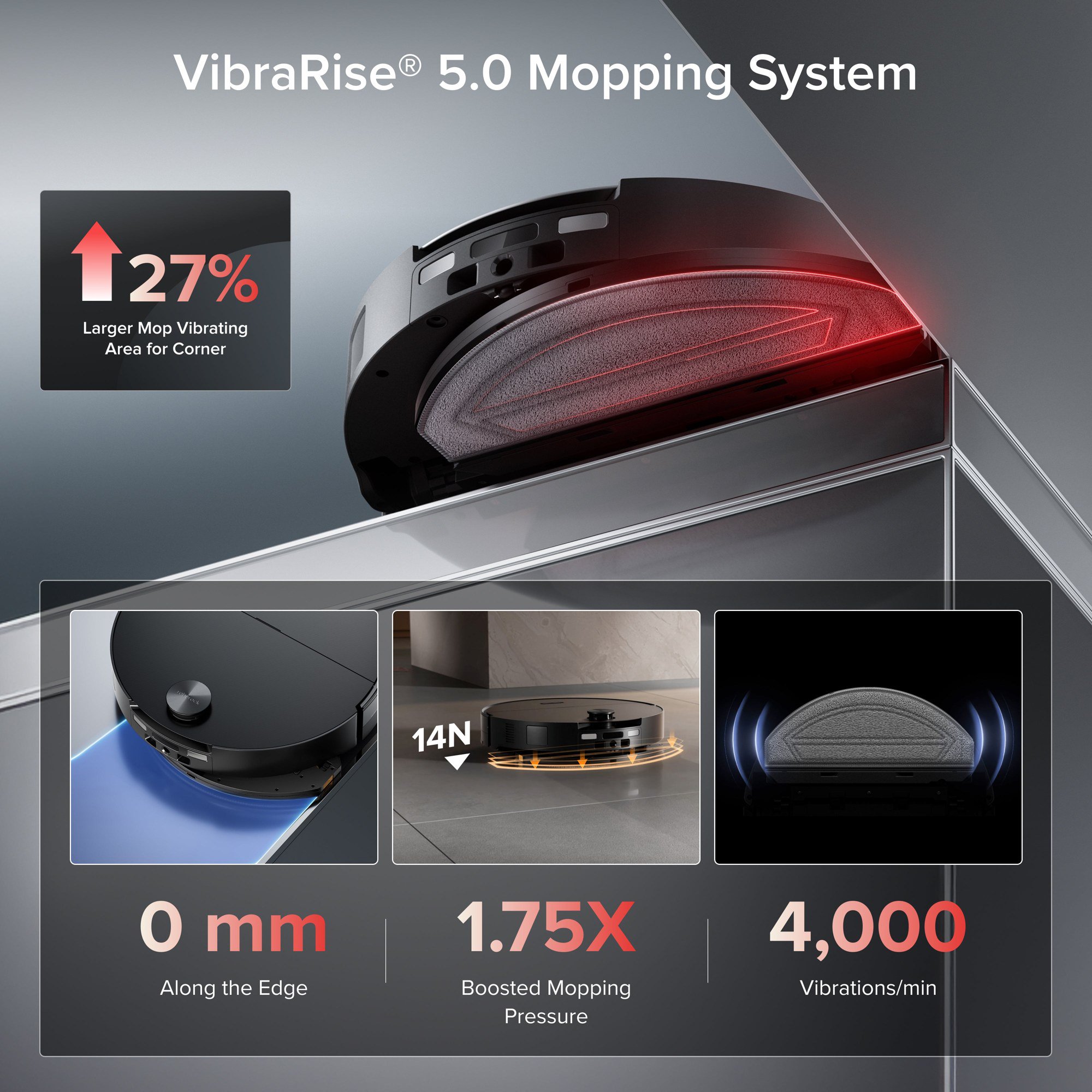
Official comparison typography is blunt about mopping. “The Saros 20 is equipped with a dual rotating mopping module, which uses two high-speed spinning mop cloths to simulate manual scrubbing.” “The Saros 20 Sonic features the VibraRise 5.0 high-frequency vibrating mopping system, with an extendable mop that applies 14 N of downward pressure, suitable for users who prefer intensive, pressure-based floor scrubbing.” Official Saros 20 FAQ typography, when comparing with Saros 10R, gives Saros 20 downward mop pressure “up to 13 N.” Official Sonic typography therefore prints a higher official pressure figure, 14 N, and official Saros 20 typography prints 13 N. Those are official newton figures, not pad-pressure measurements taken here.
Official Sonic FAQ typography adds that VibraRise 5.0 “has removed Edgewise mopping module and adopts an extendable mop design,” and that 14 N “combined with 4,000 vibrations per minute” is the official stain-removal typography, with official wording that “overall system noise has been significantly reduced.” Official Sonic product typography also says the shopper can “Take full control with independent water and vibration settings in your app,” with official examples that pair lower water with hardwood typography and higher water flow with kitchen typography. Official Saros 20 typography instead emphasizes mode-based lifting: mop detached and chassis lifted for carpets, mops detached for vacuum-only, and mops lowered with the main brush lifted for mop mode. Official FlexiArm typography on Saros 20 says both the side brush and mop can extend into corners and edges. Official Sonic typography also describes an extendable mop for corners and edges, and official curtain-mark typography appears on the Sonic product page.
Official dock typography is presented as shared in the comparison FAQ: 212°F hot-water mop washing and dust-bag drying. Official homepage typography for Saros 20 also prints “100°C hot water mop washing.” Official Sonic FAQ typography uses “mop washing at temperatures of up to 100°C” and “A new 55°C warm-air dust-bag drying function.” Official Sonic product typography uses “212°F hot water” and “131°F warm air.” 100°C equals 212°F, and 55°C equals 131°F, as temperature conversions, but official pages do not stick to one unit. Official Sonic typography also names an “independent mop washing system” so that “While the robot vacuums, the dock independently cleans your detached mop pad in the dock,” and official detergent-dispensing typography appears on the Sonic dock copy. Official Saros 20 typography describes RockDock mop-pad and dock-base washing, warm-air drying, and automatic re-wash and re-mop when heavily soiled areas are detected. This comparison records those official dock phrases without turning them into a hygiene test.
Official navigation typography: StarSight versus Reactive AI 3.0
Official comparison typography says both models “accurately detect common household obstacles and plan efficient cleaning routes, but they rely on different sensing technologies.” Official typography gives Saros 20 Sonic “the Reactive AI 3.0 obstacle avoidance system, which integrates tri-laser structured light, an RGB camera, and a VertiBeam side laser to deliver stereoscopic environmental perception.” Official typography gives Saros 20 “the StarSight vision recognition system, which offers exceptional visual detection and identification capabilities.” Official Saros 20 product typography also names StarSight Autonomous System 2.0, 3D ToF sensing, and “recognition of over 300 types of obstacles.” Official Sonic typography emphasizes VertiBeam “lateral structured light” for slim obstacles along walls, plus DirTect typography that “uses an RGB camera to identify heavy dirt and stains.” Official Sonic typography also says visual data is processed “securely on-device.”
Those official sensor names are not interchangeable, and this comparison does not declare one official system more accurate. Official typography itself says the choice “depends primarily on your preferred mopping method,” not on an official ranked navigation score.
Official low-clearance typography is close on both pages. Official Saros 20 typography says “as low as 3.13 inches,” while official specifications list robot dimensions of 13.78 × 13.90 × 3.14 in. Official Sonic typography says “3.13 inches Low-Clearance Capability,” while official Sonic specifications use metric typography: “Robot Dimensions: 35035379.8 mm” and “Battery Type: 6400 mAh.” 79.8 mm is 3.14 inches if converted, which again leaves official clearance typography and official dimension typography one increment apart. Official Sonic specification typography also lists retail box dimensions of 535474429 mm, box weight 19.61 kg, and robot-plus-dock weight 14.33 kg, whereas official Saros 20 specification typography is in inches and pounds. This comparison keeps each model’s official unit system rather than inventing a single unofficial converted table for every line.
Official threshold typography has the same kind of split. The official comparison FAQ says both models share a “3.46 in double-layer threshold.” Official Sonic FAQ typography, when comparing with Saros 10, uses “double-layer thresholds up to 4.5 cm + 4.3 cm.” Official Saros 20 FAQ typography, when comparing with Saros 10R, uses “1.77 in + 1.69 in.” This comparison records all three official forms and does not replace them with one unofficial sum.

Official Saros 20 Flow typography, kept separate
Official US typography also sells Saros 20 Flow as a third current Saros 20-family model, and official catalog typography listed it at $1,499.99 on November 19, 2026, with official compare-at typography of $1,699.99, SKU RR-Saros20Flow5-M1. Official product typography names “SpiraFlow 2.0 Pressurized Self-Cleaning System,” a “36,000 Pa HyperForce digital motor,” and “the all-new RockDock.” Official specification typography for Flow is metric and is not identical to Saros 20 or Sonic: “Robot Dimensions: 35235389.8 mm,” dock typography of 381454451 mm, and net-weight typography of 5.2 kg for the robot, 10.1 kg for the dock, and 15.6 kg for robot, dock, and accessories. 89.8 mm is 3.54 inches if converted, and official merchandising typography for Flow uses a “3.54 inches Ultra-Slim Design” line. That official height typography is not the same as the 3.14-inch / 79.8 mm typography used for Saros 20 and Saros 20 Sonic.
Official Flow packing typography lists a robot vacuum, multifunctional dock, dock base, user manual, and power cable. Official typography does not, in the comparison FAQ quoted above, fold Flow into the rotating-mop versus VibraRise choice. This article therefore keeps Flow as a third official mopping design, not as an unofficial synonym for either compared model.
If official rotating-mop typography at the official $1,599.99 snapshot is the closer match, official pages point to Saros 20. If official VibraRise 5.0 typography, 14 N, and 4,000 vibrations-per-minute typography at the official $1,699.99 snapshot is the closer match, official pages point to Saros 20 Sonic. If official roller-mop typography matters more, official pages point to Saros 20 Flow as a separate model. Confirm live official prices and live official specification tables through /go/roborock. This official-page comparison does not rank cleaning results.
References
- Roborock Saros 20 official product page, including the official comparison FAQ
- Roborock Saros 20 official landing page
- Roborock Saros 20 Sonic official product page
- Roborock Saros 20 Sonic official landing page
- Roborock Saros 20 Flow official product page
- Official robot vacuums merchandising page
- Roborock US Official Store homepage
- Official Terms and Conditions
Meet your guide
Lipeiguan
author
What to read next
 Best Roborock Robot Vacuums on the US Official Store in 2026: Official FAQ On November 19, 2026, the Roborock US Official Store merchandised the Saros 20 as a 2026 flagship at a $1,599.99 listed price, alongside the Saros 20 Sonic at $1,699.99, the Saros...
 How to Set Up and Use a Roborock From the US Store and the Official App Official Roborock US typography says the Roborock App is used to map a home, set cleaning schedules, mark No-Go Zones, and customize cleaning strategies, and that the app is not av...
 Roborock US Official Store Shopping Guide: Shipping, Returns, and Warranty Official Roborock US shipping typography says shipping is free with the purchase of any Roborock vacuum and that delivery is limited to the contiguous United States, excluding Alas...